




3PL vs In-House Warehousing: A Complete Cost Comparison for Small and Medium Businesses
As your business grows, so does the complexity of your warehouse operations. One of the most important decisions you’ll face is whether to manage warehousing internally or outsource it to a third-party logistics (3PL) provider.
At first glance, operating your own warehouse may appear to be the more cost-effective option. However, many businesses underestimate the ongoing operational expenses and hidden costs involved. A 3PL, on the other hand, typically operates on a flexible, usage-based pricing model that allows companies to convert fixed costs into variable ones.
In this guide, we’ll compare 3PL vs in house warehousing, explore the true cost of each model, and show you how to evaluate outsourcing warehouse cost using a practical ROI approach.
What Is In-House Warehousing?
In-house warehousing means your company owns or leases warehouse space and manages every aspect of storage, inventory, and order fulfillment internally.
Typical responsibilities include:
- Leasing or owning warehouse space
- Hiring and managing warehouse staff
- Purchasing or leasing equipment
- Implementing a Warehouse Management System (WMS)
- Managing utilities and maintenance
- Purchasing packaging materials
- Ensuring compliance with health and safety regulations
- Overseeing inventory accuracy and fulfillment performance
While this model offers maximum operational control, it also requires continuous investment in people, infrastructure, and technology.
What Is a 3PL Warehouse?
A Third-Party Logistics (3PL) provider manages warehousing and fulfillment on behalf of your business.
Instead of investing in physical infrastructure, businesses typically pay for the warehouse capacity and services they actually use. Pricing usually depends on factors such as storage volume, inbound shipments, order fulfillment, and any additional value-added services.
This allows companies to scale logistics operations without taking on significant fixed overhead.
3PL vs In-House Warehousing: Cost Comparison
The biggest difference between these two models isn’t simply the total cost, it’s how those costs are structured.
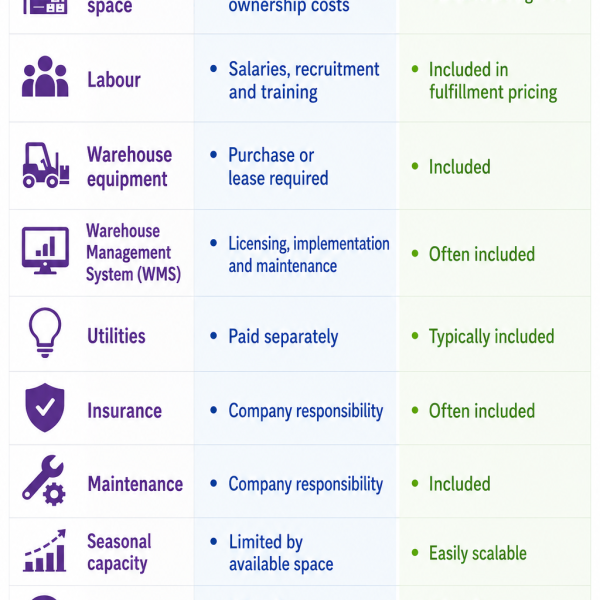
For many small and medium-sized businesses, the flexibility of a variable-cost model becomes particularly valuable during periods of fluctuating demand.
The Hidden Costs of In-House Warehousing
Warehouse rent and employee salaries are only part of the picture. Several indirect costs are often overlooked when businesses compare warehousing models.
Employee Recruitment and Retention
Hiring, onboarding, training, and retaining warehouse staff requires both time and financial investment. High employee turnover can significantly increase operating costs.
Technology Investments
Modern warehouses rely on Warehouse Management Systems, barcode scanning, inventory tracking, and software integrations. These systems require implementation, updates, support, and ongoing maintenance.
Equipment and Maintenance
Forklifts, shelving, conveyors, scanners, and packaging equipment all require regular servicing, repairs, or replacement over time.
Compliance and Risk
Operating your own warehouse means managing workplace safety, insurance, regulatory compliance, and quality standards internally.
Underutilized Warehouse Space
One of the largest hidden costs is paying for warehouse capacity that isn’t fully utilized during slower periods. Fixed expenses continue regardless of how many orders are shipped.
Understanding Outsourcing Warehouse Cost
Many businesses ask, “How much does warehouse outsourcing cost?”
A more useful question is:
“How much is my current warehouse really costing my business?” Instead of comparing monthly invoices alone, consider the total cost of ownership, including:
- Warehouse rent or mortgage
- Employee salaries and benefits
- Recruitment and training
- Warehouse software
- Equipment purchases or leasing
- Utilities
- Insurance
- Maintenance
- Management time
- Opportunity cost of invested capital
Only after calculating these costs can you make an accurate comparison with a 3PL pricing proposal.
How to Calculate Warehouse Outsourcing ROI
Rather than relying on generic cost estimates, calculate the return on investment using your own business data.
ROI Formula = (Current Annual Warehouse Costs − Annual 3PL Costs) ÷ Annual 3PL Costs × 100
When calculating your current warehouse costs, include both direct and indirect expenses – not just rent and payroll.
This approach provides a much more realistic picture of the financial impact of outsourcing.
Benefits of Outsourcing Warehouse Operations
When evaluating outsourcing warehouse cost, businesses should also consider the operational advantages a professional logistics partner can provide.
These often include:
- Reduced upfront investment
- Predictable operating costs
- Improved scalability
- Faster implementation
- Access to warehouse technology
- Experienced logistics professionals
- Greater flexibility during seasonal demand
- Reduced management complexity
- Better inventory visibility
- Potential shipping savings through carrier networks
For growing businesses, these benefits can create value beyond direct cost savings.
When In-House Warehousing Makes Sense
Managing your own warehouse may be the right choice if:
- Your order volumes are consistently high.
- You require highly specialized warehouse processes.
- You already own warehouse facilities.
- Your operations remain stable throughout the year.
- Maintaining complete operational control is a strategic priority.
In these situations, long-term economies of scale may justify the investment.
When a 3PL Is the Better Choice
A 3PL is often the preferred option if your business:
- Is growing rapidly
- Experiences seasonal demand fluctuations
- Wants to reduce fixed operating costs
- Plans to expand into new markets
- Lacks internal warehouse expertise
- Needs additional storage capacity without investing in infrastructure
- Wants to improve cash flow and operational flexibility
For many SMEs, outsourcing warehousing enables management teams to focus on business growth rather than daily logistics operations.
Final Verdict
The decision between 3PL vs in house warehousing depends on your business model, growth strategy, and operational requirements. While operating an internal warehouse offers greater control, it also comes with significant fixed costs, ongoing investments, and management responsibilities. A 3PL shifts many of those expenses into a flexible, usage-based model, allowing businesses to scale more efficiently while reducing operational complexity. Before making a decision, calculate your total warehouse operating costs rather than comparing rental prices or fulfillment fees alone. Looking at the full financial picture will help you determine which model delivers the strongest long-term return on investment.


